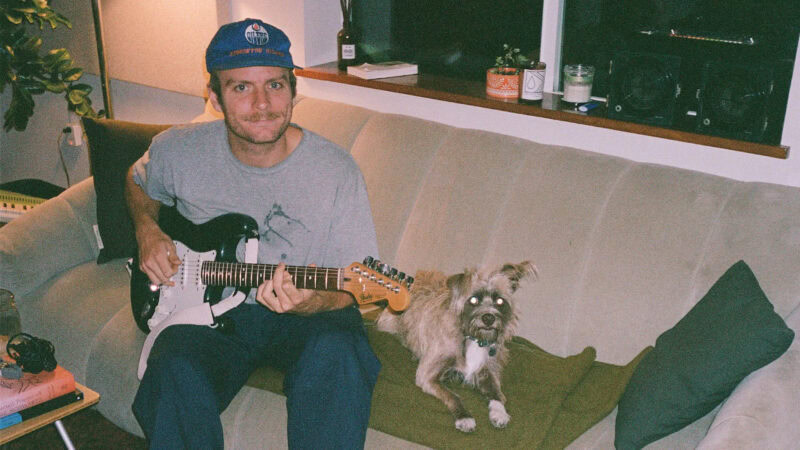
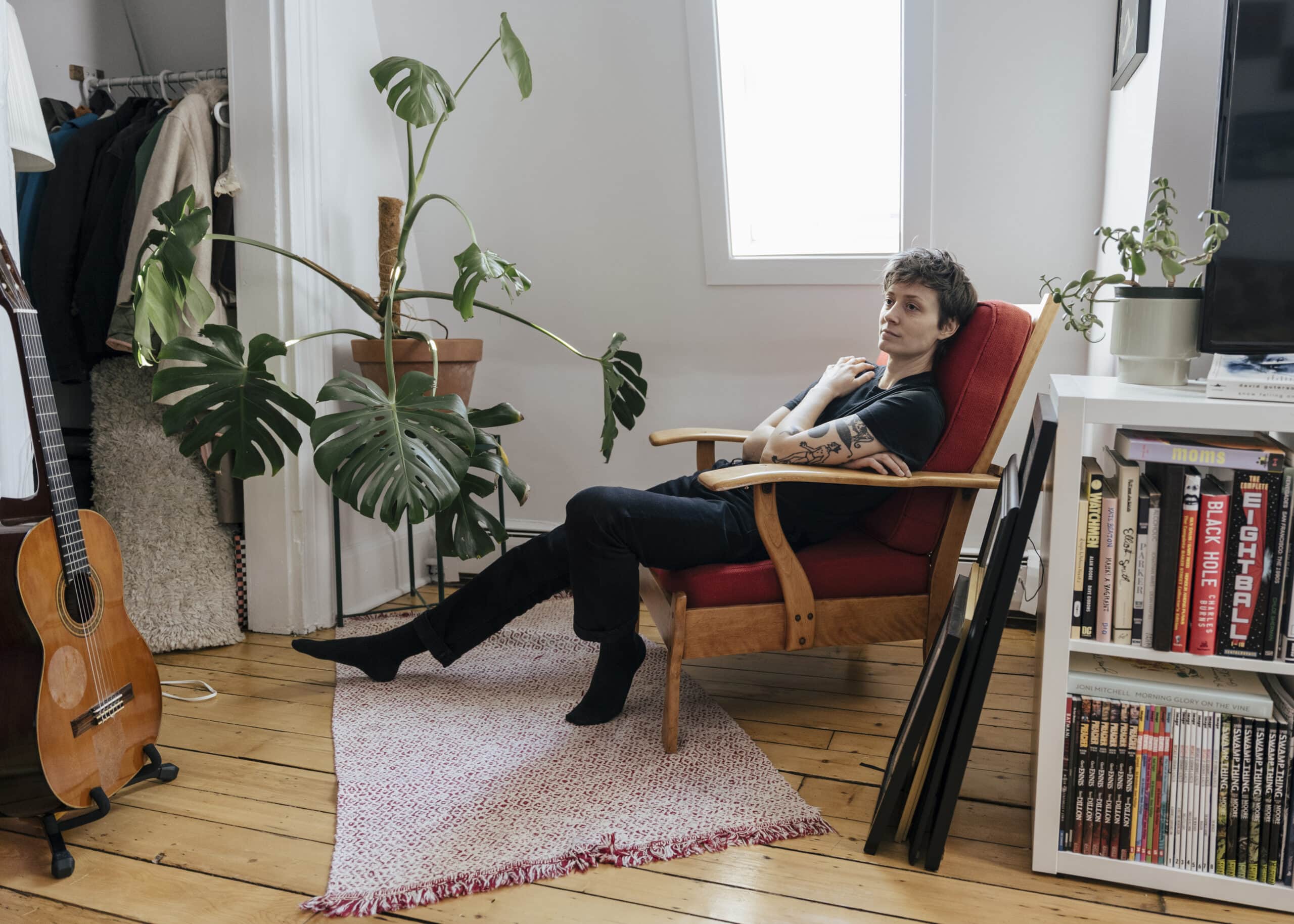
Whether Mo Kenney is shredding, as on the glitchy chaos of 2017’s “If You’re Not Dead,” or fingerpicking their Hensel acoustic guitar on tunes like 2024’s “Self Doubt,” there’s often a mesmerizing quality to their music. Some of that has to be attributed to the dreaminess of the Dartmouth, Nova Scotia-based songwriter’s voice, but it may be just as much thanks to the uncanny melding they manage with their guitar.
A natural knack for the instrument might tell part of the story, but Kenney’s obsession with playing and its expressive capacities is the real source of their well-oiled work. They grew up in the Nova Scotia countryside, where guitar lessons weren’t really available, but Kenney begged and begged for lessons, inspired by their uncle Donnie as well as some inexplicable gravitation toward the instrument. Eventually, they found a way.
“I started lessons when I was 11, and I got a little acoustic guitar, like a kid’s acoustic Yamaha guitar, and just never put it down,” Kenney says over the phone from Dartmouth. “I played it constantly, even before I knew how to play chords or anything. I would just mess around on it. I was obsessed from the get-go.”
Kenney thought their teenaged uncle Donnie, who played guitar and video games and liked Batman, was really cool and fun to hang out with. He taught them how to play “Wonderwall” by Oasis, the first song they ever learned.
“I listened to a lot of classic rock, like when I was 11 and 12, and once I learned the pentatonic scale, I just started learning by ear. I would sit down and learn AC/DC solos. I learned the ‘Hotel California’ solo. I would just spend a really long time figuring it out by ear, listening to the solo over and over again. I learned all of the guitar solos on Dark Side of the Moon. When I was a teenager, I would play along to those songs and do the guitar solos in front of my friends.”
A few years later, Kenney started setting poems to their guitar playing and recording onto a cassette four-track. “I don’t remember any of the songs, and I don’t know where that cassette tape would be,” Kenney says. “But I remember how I had so much fun—I would just spend the whole day recording and experimenting.”
If you consider your entire life so far, what has the guitar meant to you? What does it mean to you now? It sounds to me that, in providing that access to experimentation and expression, it became a tool for a specific type of freedom.
First of all, I think I just thought it was cool, and I thought playing guitar would make me cool. And of course, it does—everybody knows that [laughs]. When I was in junior high, I started going to this Rock Camp place in the summer, and I met other kids who played music, and I felt like I belonged in some kind of group or community for the first time, which felt really nice. I think the more I learned about art in general, the more cool movies I was exposed to and cool music I listened to, I just felt more and more at home with myself. And then eventually it became a way for me to communicate myself and my inner world, which was something that felt really difficult at that time—to vocalize or talk about with my peers. I think it really provided an alternative opportunity to express myself in a safe way.
What draws you to it now?
There’s a more spiritual element than there would have been back then, I think. A lot of artists have talked about this—wherever a song comes from. Sometimes it comes out of nowhere, and it happens so fast that it feels like you didn’t even write it, that it came from somewhere else. I feel like continuing to make art keeps me connected to whatever that is, which I think is a spiritual plane of some sort.
So what’s the deal with your Hensel?
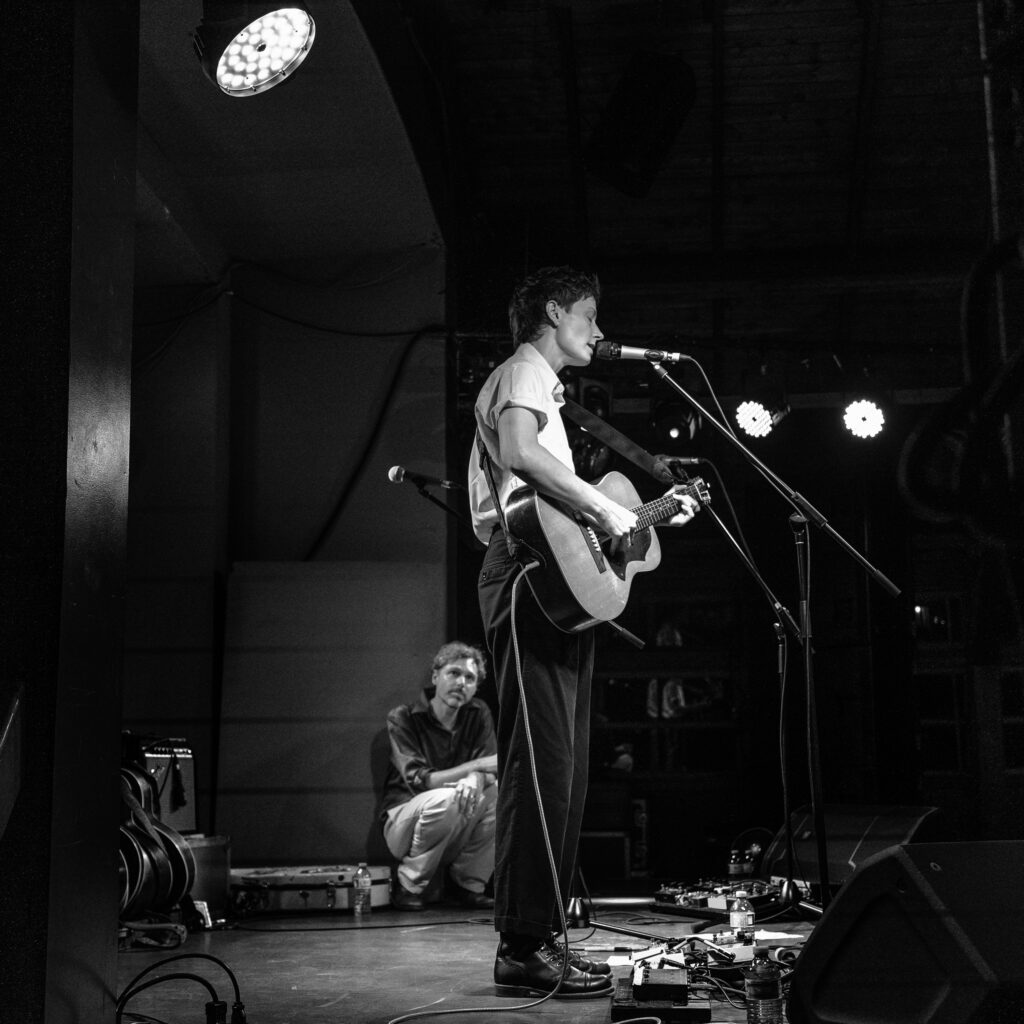
I had a Seagull acoustic guitar, which was great, but it was really big, and I was quite skinny when I was 19, 20. It just looked enormous on me, and I felt like I couldn’t wield it properly or something. So I wanted a smaller parlour-sized guitar. And I wanted something really nice, because I was starting to play a lot of gigs at that time. I mentioned to Joel Plaskett that I was looking for a new acoustic and he directed me to the Folklore Centre in Halifax and Tom Dorward, the owner and luthier, who recently passed away. He would get these Hensels in every once in a while and restore them. I know a few other people who have these guitars. Joel said Tom had one in and I should go check it out, because he thought I would like it. So I went into Halifax, and I think I’d just won the SOCAN Songwriting Prize. So I had a little bit of money. And I sat down and played this guitar. I took a little walk around the block, and then I bought it, and I was so happy, and I still love it so much. Every time I go play a gig and I plug in my acoustic guitar, without fail the sound person will be like, “That guitar sounds really, really good.”
What makes it particularly suited to your style of playing? What do you require from an acoustic guitar to feel comfortable that it’s doing what you need it to do?
I think partly it’s the pickup I have in it. It’s called a Fishman Rare Earth pickup, which can pick up all the little details of the fingerpicking with a lot of clarity. I use heavier gauge acoustic strings. Even though it’s a parlour, it can handle medium gauge strings. I just like the sound of medium gauge strings better. And it feels really nice in my hands. It feels nice to play. At this point, I’ve had this guitar for like, 16 years now, and I’ve played it pretty much every day for those 16 years. So it really is essential to me. I feel very attached to it. I don’t know what I would do without it. I know I’ll have it for the rest of my life.
Do you think your feelings create your style, or vice versa?
I’m not thinking about style. It’s definitely feelings-driven.
So you never think, “I have a feeling, and now I’m going to make a sound that expresses that feeling”? You start playing, and you’re in sync enough with your instrument that the thing that’s meant to happen just happens?
Yes. I think so. Let me think about this for a minute. I feel like, usually, if I’m sitting down with the intention to start writing something, I’ll just noodle absent-mindedly. And if something makes me feel something, I’ll chase that. I think that’s the spiritual element I mentioned—you just trust that it’s gonna happen.