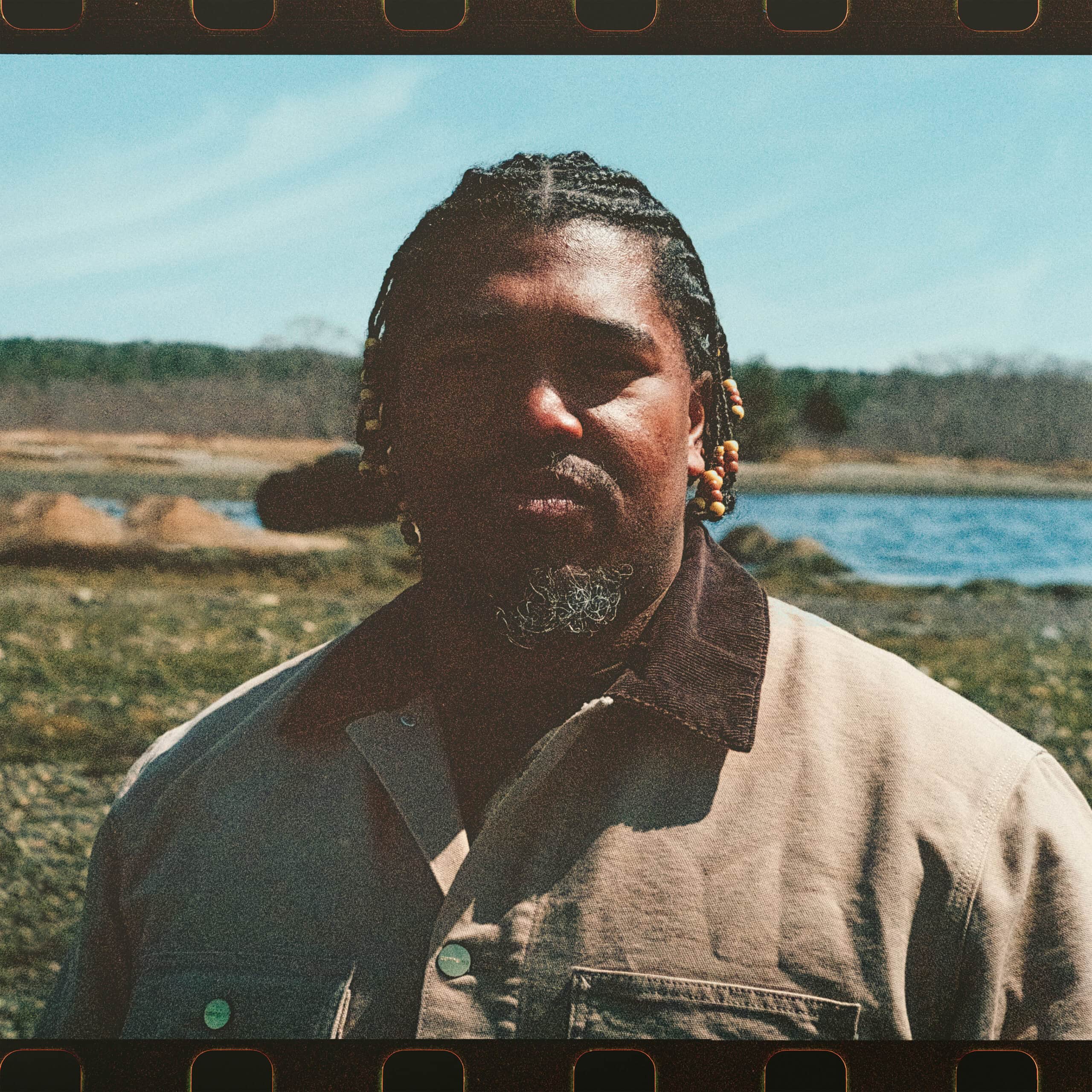
When Lance Sampson — known on stage as Aquakultre — appears on screen in our video call, the light behind him is pale and winter-bright. Snow sits thick outside his window in Dartmouth, Nova Scotia, quiet and undisturbed. He corrects me gently when I reference Halifax as his base.
“Dartmouth,” he says with a small smile. “Halifax and Dartmouth are very, very close. They’re separated by a couple bridges. But I’m in Dartmouth.”
It is not a defensive correction. It is precise. With his story, geography matters. The distinction between one side of the harbour and the other matters. Over the next hour, it becomes clear that this instinct toward specificity animates his new album, 1783. Not just Nova Scotia. Not just Canada. Dartmouth. Liverpool. Weymouth Falls. Named places. Named people. Named inheritance.
Released via Next Door Records, 1783 is the fourth studio album from Lance Sampson and the most expansive statement of his career. Across seventeen tracks, he moves through soul, R&B, gospel, folk, and hip-hop without signaling the transitions. The genres blur seamlessly into one another, stitched together by a voice that feels both grounded and searching.
Produced by two-time Music Nova Scotia Producer of the Year Erin Costelo, mixed by Grammy winner Qmillion, and mastered by multi-Grammy nominee Chris Athens, the album carries technical pedigree. But the polish never overwhelms the intimacy. Instruments sit back when they need to. Harmonies swell and recede, and the record feels considered rather than decorated.
The title 1783 refers to the year thousands of Black Loyalists arrived in Nova Scotia following the American Revolutionary War. Promised land and autonomy for their allegiance to the British Crown, many instead encountered broken promises, segregated settlements, and harsh conditions. For Sampson, that year is less a history lesson than a point of origin.
“That’s when a large group of Black folks came to Nova Scotia,” he explains.
“A lot of the communities that my family is from, that’s kind of where it begins in terms of written history.” He pauses before adding, “But even then, it’s fragmented. It’s a church record. It’s stories passed down.”
The album feels like an attempt to stitch those fragments into something cohesive and lived. Aquakultre has always centred Black Nova Scotian identity in his work, but 1783 approaches it with deeper excavation.
His 2023 album Don’t Trip earned a Polaris Music Prize longlist nod and broadened his audience nationally. That record moved outward, confident and rhythm-forward. This one turns inward. The shift is subtle but profound, with songs that carry a quieter weight and are less concerned with assertion and more with reflection.
“What I understood pretty quickly as I got older,” he says, “is that there’s still a lot of people in Canada that have no idea about the 400-year history that exists when it comes to Black folks in Nova Scotia.”
He includes himself in that ignorance: “I actually didn’t know much either. I had no idea what that means to be African Nova Scotian. No idea. I just know that that’s what I’ve been called.”
This realization pushed him into research, not surface-level Googling but deep archival digging through church histories, migration records, and oral storytelling. He soon became fascinated by the three major Black migrations into Nova Scotia: the Black Loyalists in 1783, the Jamaican Maroons in 1796, and the Black Refugees in the early 1800s.
“With that comes a lot of musical influence and tradition that they’re bringing down,” he explains. “Gospel, funk, country, folk, bluegrass, jazz — it all exists within the Black diaspora of Nova Scotia.”
One of 1783’s emotional centres is “I’ll Be Damned,” rooted in the life of his uncle Derek Johnson.
“This song is inspired by my uncle Derek Johnson who grew up in Liverpool, Nova Scotia,” he says. “He was the black sheep of the family. He got into a lot of shit. He didn’t play with nobody.”
Derek left rural Nova Scotia for the city, a trajectory familiar to many from historically Black communities facing limited economic opportunity.
“Like a lot of these folks that left these rural areas, they came to the city and got themselves into trouble,” Sampson explains. “My uncle came into the city and married a lady named Joan Brooks. They married real young. They had a lot of kids and did their best to raise them.”
“I’ll Be Damned” does not shy away from complexity.
“My uncle was dealing with what happened to him, racism and abuse,” Aquakultre says. “He didn’t know how to love a woman. He didn’t know how to raise kids. His image was of his dad, my grandfather, who was an evil dude.”
There is no dramatization in that delivery, and the track holds Derek’s story without condemnation or romanticization.
Long before 1783, there was Lex, the teenage rapper in a Halifax basement writing sixteen bars at a time.
“I was just talking about stuff that wasn’t me,” he says now. “I was just really kind of rapping and writing about things that didn’t exist within my life at the time.”
Halifax, he explains, can box you in quickly.
“People love the genre here. You got to get boxed in. Oh you’re this, you’re this.” He rejected the box. “I was like, actually, no, I’m not. So I’m gonna release a singer-songwriter kind of thing.”
This transformation from Lex to Aquakultre was not about reinvention but about truth.
“There was something within me throughout my whole life that needed my voice to be heard outside of the confines of my house.”
He grew up in the Uniacke Square housing projects.
“The houses are so small… If I’m just speaking to you like this, your mother’s telling you to shut up because it’s just so loud.” Naturally, silence becomes culture in environments like that. “We kind of grew up in a neighbourhood where you mind your own business, don’t say nothing…You’re kind of ingrained in silence.”
Music broke that silence.
“I realized that my voice was an instrument really early,” he says. “And I just really want to sing.”
One of the most startling discoveries during his research for 1783 was not musical. It was genealogical.
“Everybody is everybody’s cousin,” he says bluntly. “Like, it’s crazy.” He describes traveling two and a half hours to Weymouth Falls and discovering dozens of people carrying his great-great-grandmother’s surname.
“There’s 70, 80 Cromwells…cousins. I go to East Preston, cousins.” In Nova Scotia, family trees overlap: “We are one, two, three, six degrees separated from knowing every single person in this province.”
That closeness reshaped his understanding of community and the generational gaps within it.

He tells me about discovering, in his 30s, the origin of the province’s 4 Plus preschool system, a biracial church partnership designed to combat racism in the 1970s.
“Why is it that I’m 30-something years old learning about all this stuff?” he asks. The elders told him something sobering. “We did a lot of the work, but we did a terrible job at passing it down.”
1783 is Aquakultre’s attempt to fix that, and becoming a father even intensified this purpose.
“This record started with me knowing that if my children were to ever try to have a conversation with me about Black identity and history within Nova Scotia, I wouldn’t be able to tell them,” he says. “So selfishly, this record is a lesson for them.”
With this project, Aquakultre refuses the traditional album cycle. He explains that he does not want the work to fit into the conventional rollout structure that most albums follow. Instead, he sees himself thinking about and developing the project over the next two to three years. He points to Leon Bridges touring Coming Home for five years as a reference point. For now, with this project out, he is not thinking about anything else. He simply wants the space to breathe.
Before we end, I ask what he would tell young Black artists navigating an era of social media noise and cultural pressure.
His answer is immediate:
“If you still have grandparents, spend as much time as you can with them and ask them as many questions as you can about who they were before they were parents. Surround yourself with people that elevate you…Be comfortable with your gut feelings.”
And artistically?
“Be very intentional with what you’re doing and try not to follow the trends…Auto-tune is done, OK? Leave it alone.” He laughs, but he’s serious. “Just try to be different.”
As the interview wraps, he checks the time. It is still morning in Dartmouth, and he is about to exercise before work. The snow remains outside, unmoving while the world rushes at algorithm speed. Aquakultre moves at archival speed. He is deliberate and community-centred.
“I’m just happy I get to contribute to that conversation,” he says. And he is contributing in a way that matters, building something that will outlast a single album.