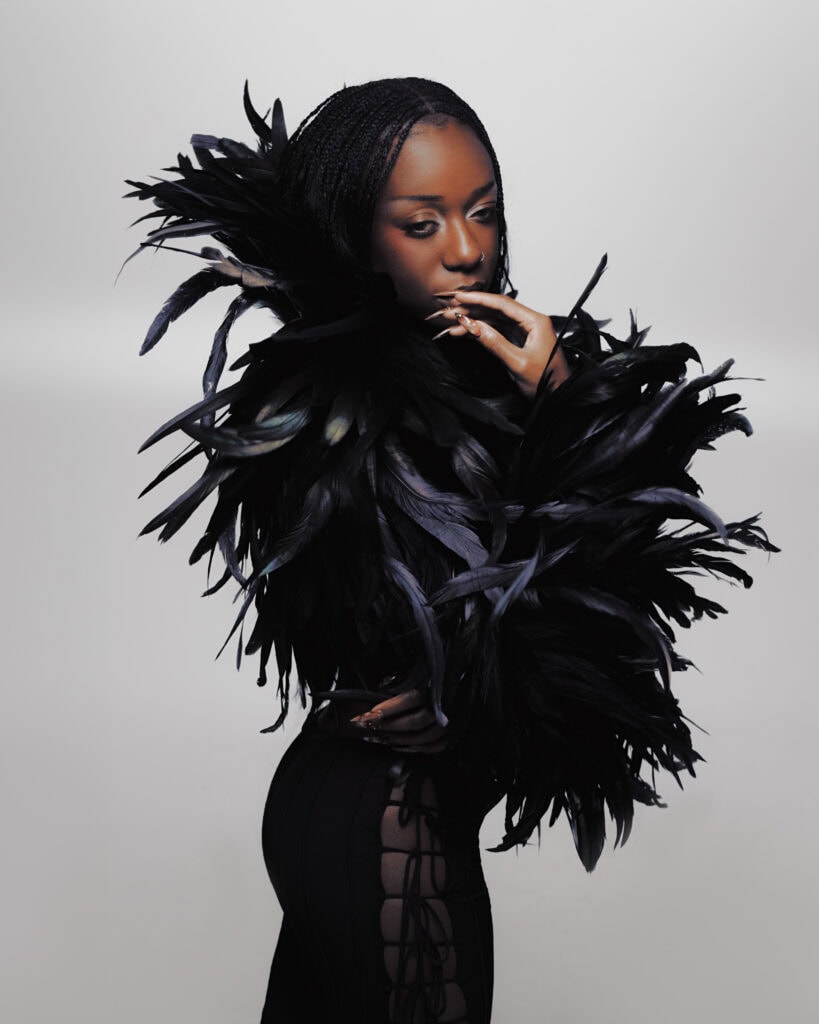
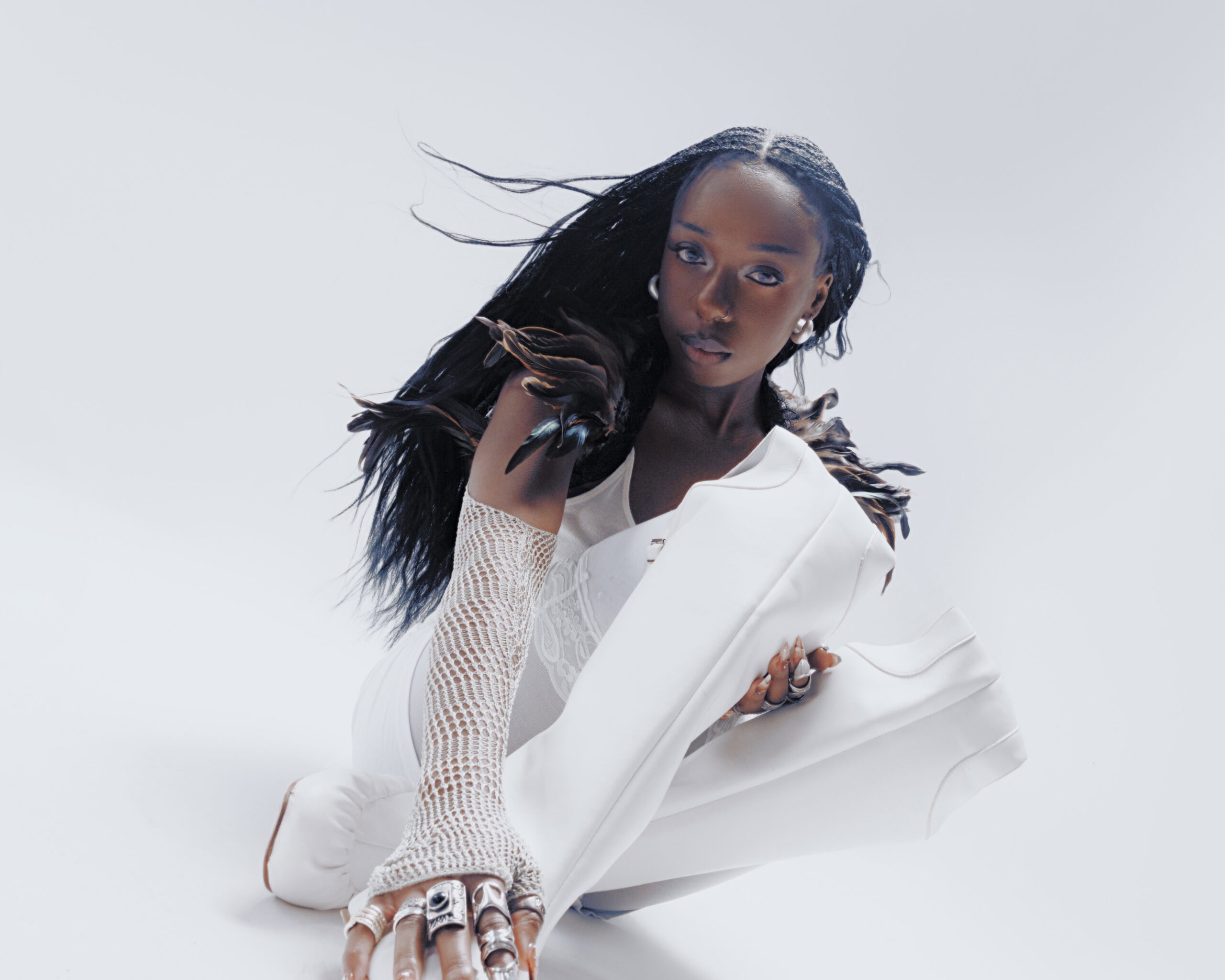
The tension and relationship between the digital and analog worlds is on Debby Friday‘s mind lately.
The first 2026 episode (‘void space‘) of the Toronto-based electronic musician, writer, filmmaker, and philosopher’s podcast debby diaries digs into a lot, as most of the episodes do—”… logging off, being online, the history of the internet, in-between-ness, TikTok, Solvej Balle’s On The Calculation of Volume I, social media, time loops, and much, much more,” as Friday’s description notes. It’s a relationship she’s been navigating for many years now, having had access to a personal computer early in her life (her dad used to do computer science) and cultivating a notebook habit since before she can remember.
“The computer and the notebook both function as this kind of mind dump, a place where you can extend your mind and put things into it that are coming out of your mind or out of your body, and they both deal with the mind in different ways,” Friday says over the phone from Toronto. “With the computer, you’re using your mind to manipulate these digital atoms in a way to create things digitally, right? It’s not necessarily a tangible product—when I’m making a song on Ableton, it’s not something I could hold in my hand—but it’s a real thing. It’s a real song that can later be made into a thing when you press it to vinyl, make a CD, whatever it is. That’s one way of transmuting ideas into materiality. It’s the same with the notebook. You have all these ideas and jumbled thoughts, and when you write them down in the notebook, they become real things. They’re not just thought forms anymore, they’re written words.”
Friday’s debut album GOOD LUCK earned an onslaught of praise for its propulsive, aggressive arrangements and cryptic, shadowy lyrics. It wound up winning the 2023 Polaris Music Prize. Her latest, The Starrr of the Queen of Life, is filled out by club odysseys (“All I Wanna Do Is Party”), moments of sensual mysticism (“Higher”), and a poignant episode of grief (“Leave.”).
All of these songs trace their origins to her notebooks and computer. She can remember her household being one of the first of those she knew as a kid to have laptops. She remembers the sound of dial-up internet. And since those first days learning to use the computer, she’s understood it as a kind of “magic box”—the gateway to the internet and tools of creation.
“It wasn’t like you were actually manipulating something with your hands; you were working with your mind,” Friday says. “And I saw the internet as this gateway to the world and to culture, because I grew up in a very strict household. But it was also a gateway to this collective consciousness that was in the world, because it really functioned as this brain dump, right? On the early internet, people just put whatever on there. I used to surf the web all the time and find all these really cool, interesting, weird, very strange corners of the internet and different websites, before social media, and it opened me up to so much. I always saw it as this digital fantasy world where pretty much anything was possible.”
She points out that she marks a distinction between ‘computer time’ and ‘phone time,’ considering the phone typically more of an entertainment machine—’a time suck’—than a tool used to create the aforementioned tangible things. When she was younger, she tinkered around with coding, built websites, played a Sims-esque game called IMVU where one can create their own avatar, and wrote and posted fan fiction online. When it came to music, she learned to make it through the computer as well.
“I’m not classically trained,” Friday says. “I play a few instruments, not very well, and I have an ambient knowledge of music theory, is how I would describe it. But the way that I actually learned how to make music was through my computer, looking at YouTube tutorials.”
Notebooks have also been a part of her life since she can recall. She’s always written in a notebook—she was a writer before she was a musician—and considers it her first creative endeavour. They’re where she did (and still does) write down all her ideas, poetry, and stories, and every project she starts has its own dedicated notebook.
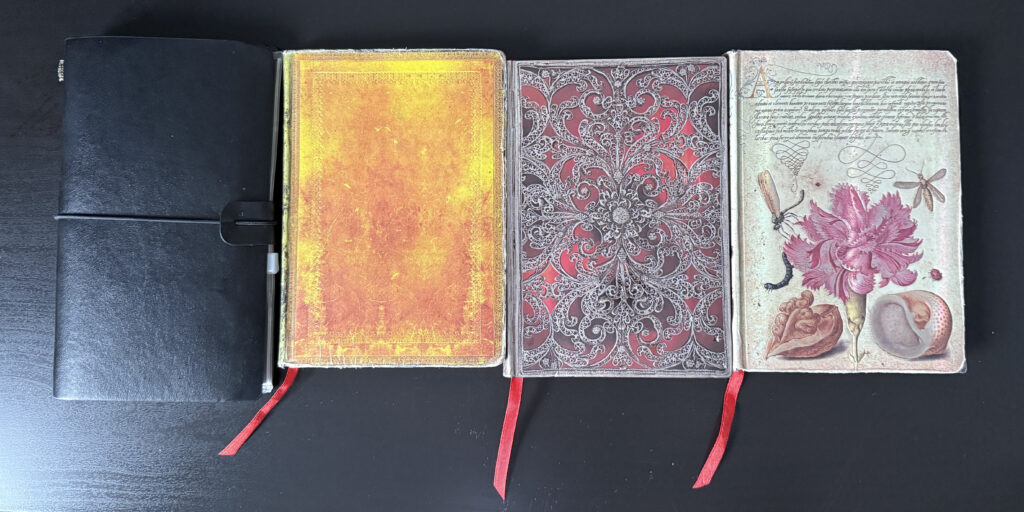
“I like to use unlined notebooks, because you can really go off script and get kind of crazy and out of the box, and whatever comes into my mind, I can put it onto the page. I have boxes and boxes of notebooks that I’ve collected throughout the years that are just filled with project ideas, stories. There are books in there, journals, songs, poetry. And my notebook feels like an instrument to me as well, because I really believe in writing things down. I see it as a way of concretizing ideas so you can make them real. I think there’s something significant about the practice of writing with your hands and not just typing it on the computer. It’s a body memory thing, a way of engaging in active thought.”
So what is your notebook ecosystem like?
I work intuitively. When I feel like a notebook is done, or an era or project is coming to a close, even if I haven’t finished the notebook, I stop using it and put it away. But I have multiple notebooks going at a time. I have one that’s more for daily journaling, because I write every day, and then I have one that’s project-based, so whatever project or two that I’m working on at the time, they’ll each have their own notebooks, and then I have another one that’s more abstract. It’s kind of hard to describe what it’s for. It’s mostly for stuff that doesn’t fit in the other two notebooks. And then I have another notebook that’s for my dreams. I’ll go back and flip through sometimes just to see, like, “Okay, what am I dreaming about? What am I thinking about? What’s going on in my mind that I’m not necessarily consciously aware of?” Collecting my dreams has been really interesting. I’ve been doing it a lot more lately, and seeing threads of ideas between my waking life and my sleeping life.
How do you use the computer in your music-making?
My computer is my instrument. I produce everything that I make, and I do it all electronically. Well, usually it’s all electronically. Sometimes there’ll be real instruments, but I produce on my computer. So when it comes to starting a song, I open up Ableton and just try to find sounds that I like, going off intuition, because I’m not classically trained. I have a finely tuned ear, and so it’s all about what feels or sounds right to me. Then I build a skeleton of a track. As soon as I have the skeleton, I have to go to the words right away. I want to get down, like: “What am I trying to say? Is this a song with vocals? Is it not?” And I go to my notebook and then I write. I use them both at the same time when it comes to songwriting. If I’m working on an album, I have a co-producer, so I’ll build out the skeleton of a track and then work with my co-producer to finish the song.
What did that process look like for The Starrr of the Queen of Life?
I was lucky enough to have Darcy Baylis with me, and we made the album in the studio together. In that situation, this weird thing happens where… I don’t want to say I was relating to him as an instrument, just because he was the one who was mostly at the computer and I was in my notebook. But it was a weird, symbiotic thing that was happening, where we kind of became this fused entity. Like when you’re working really closely with somebody, and especially when it comes to producing, because it’s your mind that is the primary instrument, right? The mind being interpreted through the computer. And then you’re the instrument, the other person’s the instrument, the computer’s the instrument, the notebook’s the instrument. Everything that’s in the room becomes an instrument to get out the idea or the vision.