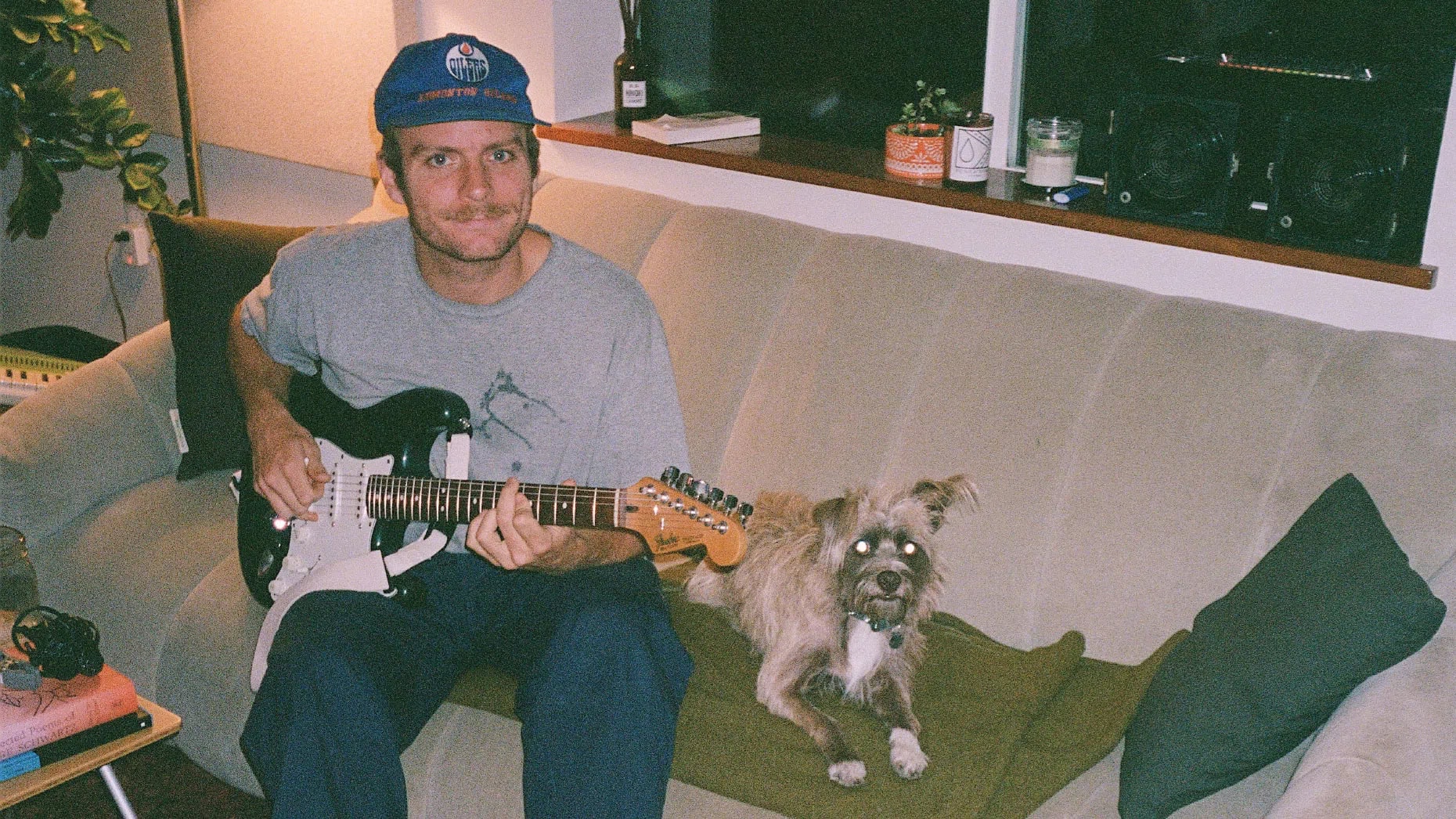
On a very cold day in mid-December, Mac DeMarco is at the Burton Cummings Theatre in downtown Winnipeg for the first of two shows in town. He’s on the road promoting his new record Guitar, a gentle and intimate collection of songs aptly named—nestled in extremely low-key production, DeMarco’s voice and soft guitar float breezily to the forefront. There is a line of new merch items that feature simply the word “Guitar” in the same font as the Government of Canada wordmark, complete with a tiny little Canadian flag. But for most of the set, DeMarco doesn’t play guitar at all; he jumps up and down and does hypnotic and funky dances around the entirety of the stage, or circles an imaginary spot on the floor like a fighter psyching himself up in the ring. He sings and plays with the microphone by letting go of it and then snatching it out of the air. He straps on a guitar a few times but only because he has to for certain songs.
“That was another funny thing, was having an album called Guitar when I didn’t want to play guitar in the show,” DeMarco says the following afternoon in the theatre’s green room. “We only did one show where I didn’t play guitar at all. But we try. I have to play “Freaking Out the Neighborhood.” I have to play “Ode to Viceroy.” People want to hear the songs. Those songs without two guitars sound pretty weird. And I’m happy to play guitar a little bit.”
DeMarco has been playing guitar a lot for a long time. In 2023, he released One Wayne G, an album of 199 demos that stretches for almost nine hours. And that’s just one gigantic collection in more than 15 years of professional music-making.
But DeMarco’s six-string roots run deeper than that. He grew up in a musical family in Edmonton, who mostly listened to things like jazz, classical, big band, and opera (though he notes his mom was a big ‘90s country fan). His grandmother wanted to put him in piano and singing lessons, but he refused: “I was like, ‘I don’t want to do the music, I don’t want to do this.’ I liked computers,” he says. One day, though, he had a go at his friend’s “Strat pack”—a beginner’s kind of combo composed of a Squier Stratocaster and amp—and found pretty quickly that he was better than the other kids with the guitar. So he got his own eventually.
“I think there was some impetus of like, ‘maybe the girls will think I’m cool if I can do this.’” DeMarco says. “But I don’t think that they did. I think it was just the other boys. But yeah, there was a little pack of kids in my junior high school that all had little electric guitars, and we were all fucking around with them.”
Despite DeMarco’s early rejection of some of his family’s “fancier” musical taste, his own playing is frequently at least a little jazzy, and often sophisticated in an understated way (he’s also famously coined his sound “jizz jazz”). At the end of Guitar’s “Rock And Roll,” for example, there’s a solo that’s sweet and meandering and dreamy, easy to get lost in, and perhaps simple by some measures. But it also has a lived-in, handmade feeling that’s difficult to replicate through theory. Throughout his body of work, there are plenty of examples of guitar moves that separate or elevate the playing from simply rock to something a little more idiosyncratic.
“I think the qualities of those chords or that quality of harmony has always kind of attracted me in some way, even though I didn’t really know how to maybe admit or describe that back in the day,” DeMarco says. “I’d hear songs like ‘The Girl from Ipanema’ or standards like that, and I’d be like, ‘Oh, there’s something about this I like.’ Maybe my way of trying to get somewhere like that is by using chords that maybe aren’t usually associated with classic rock or something. It’s also probably, partially, that I don’t really know what I’m doing musically. I mean, I know a little bit, but I’ll just play something. I don’t know what everything is.”
So how has your relationship to guitar changed since junior high?
I think when I first started, I wanted to emulate classic rock riffs and play these things that were already, you know… I learned how to play, like, a blues scale with other guys, soloing. And I remember being very concerned with how fast my vibrato was, like Angus from AC/DC and shit. Then I got more influenced by a kind of garage-y sound, a little bit crustier or overdriven. And now I pretty much just want the way that the instrument sounds, you know? I don’t really want it that affected, I just want to let it be what it is. It became a tool eventually, at some point, that works like a bridge to the song. The song became more important than the guitar. I think it’s maybe more so there than it has been for me for a long time. It’s the easiest thing for me to use to make the song. So it’s still there. It probably will always be, because I can’t really play the piano very well. But sometimes I can get there.
Are you usually consciously searching for a specific sound from the guitar to express a feeling? Or do you play music and then write to a feeling you recognize?
It’s easiest for me to get the feeling on guitar, because even if I don’t know where it’s supposed to be, it’s easier for me to find it, I think. And also just the way that a guitar is laid out, the way that I’ve learned to play it, the way that it has its place in my music. Maybe I’m thinking of a feeling or maybe just picking one up, is kind of like—it shows the way. I also find guitar kind of gets a bad rep sometimes, especially acoustic guitar. I saw a list of rules Kanye had in his studio as he was making Yeezus or something, and it said, like, ‘no acoustic guitars.’ And it’s kind of like, I get it, but also like, fuck you, Kanye. I think that acoustic guitar, even when I started playing it a lot more, people were kind of like, ‘What? What, do you play folk rock?’ No! It’s a good instrument! And I don’t play acoustic guitar like acoustic guitar players do, you know what I mean? It sounds a little bit different, I think.
Especially on the new record.
Yeah, it’s kind of strange. But I think the guitar is a utilitarian instrument. It’s an easy point of entry. Everybody can play a couple chords. It’s OK, you know? I like that it’s the everyman thing. It’s easy. You can pop it on your back, take it on the train. Can’t really do that with piano. I respect it in that regard.
Do you ever wonder what kind of person you might be had your instrument been, say, piano?
I think if I had been put in piano lessons when I was really young, I probably would have hated music. I feel like that’s the trajectory. Like, piano lessons when you’re really young, you do that, you hate it, but then you’re like, a teenager, and you’re like, ‘Oh, I’m actually kind of good at music because mom and dad put me in at the crack of dawn or the beginning of my life or whatever.’ I honestly think that if I had been, like, maybe, institutionalized—that’s not the right word, but, you know, in some kind of musical institution… I don’t know. I think I’m able to make the weird things that I make because I’m uneducated at it.
Has there ever been a time when you’ve been sick of guitar?
Not really. I think there was a point where it just always kind of felt like it was a part of what I do. Even if I would travel I’d usually have one with me. And if I felt sick of a way of playing it, I would try different tunings, or maybe I’d play electric more. Maybe I’d play acoustic more. There’d be things to keep it feeling fresh to me, but now it just kind of feels like another part of my voice.
There’s a part in Amanda Petrusich’s recent New Yorker profile about you when she says you feel like indie rock’s “final ambassador”—not selling out, no major label, etc. And that this kind of ethos doesn’t seem to be as much of a concern for the majority of younger artists, which I’m inclined to agree with. It made me wonder: what does music that isn’t overly professionalized look like on stage now? Does it simply still look like a band having fun? And exactly what I imagined in my head was what you guys looked like last night.
When I think about any footage of any band playing where I’m like, ‘This is awesome,’ I don’t think there are ever like, fucking props in the back, weird lights behind them. I mean, there’s obviously gonna be lights on the stage… But I want to have this thing where it’s about the music and the people. These guys that play with me are like, fucking musical geniuses, and I want to showcase them as well. So it’s partially that. I respect my songs a little bit, and do this, and we just have this kind of scalable and malleable thing. And then we can go and tour! And fuck it—we’re in fucking Winnipeg, in the winter! It’s insane. Nobody fucking does this. It’s awesome. I just want to do things that are satisfying in that way.
That part of the article—how much you love touring—was also refreshing to hear.
It’s so dope. You have to do it the right way. Things have changed, and the more DIY way of touring has been getting wiped away a little bit. There was that [Ghost Ship warehouse] fire in Oakland, and a crackdown on spaces like that. But also, that kind of community in general, there isn’t a lane for those kinds of people anymore as much as there used to be. So much shit happens on the internet that the local thing isn’t as strong in some instances. The other thing we noticed too, is that for the mid-sized indie band, even getting a Sprinter or an Econoline van that works for like, 500 [capacity venues]—it’s hard to get that rental. It doesn’t exist anymore. I remember even like, 10 years ago, there were bands “influenced by me” or whatever, very new, and they would play their first show in L.A. to like, 1,000 people.
That’s crazy.
It doesn’t make any sense. And maybe it was around this changing of the tide, when the industry was like, ‘indie rock can make money after all.’ We’re in a weird spot. And with the AI shit, too… The industry is doing this funny thing where they’re picking bands and they’ve got these new marketing techniques and new ways of tricking people on the internet to make it appear like these grassroots-seeming bands are all of a sudden just becoming the next huge thing. Hiring meme pages that are already algorithm-approved and getting them to pivot to promoting whatever band. They’ve got all these tactics, and it makes it look like people are just engaging with it. I think in some cases people do catch on and it keeps rolling. I won’t name any names, but in some cases it’s like, ‘You guys are pushing too hard, and people are going to call you on this because it’s fucking ridiculous.’ I think that, combined with the A.I. shit, and that the music industry has been overrun by Coachella-style chongos and jocks… we’re at an all-time point of it being just gross. And I think people will respond soon and not want this horseshit anymore.