
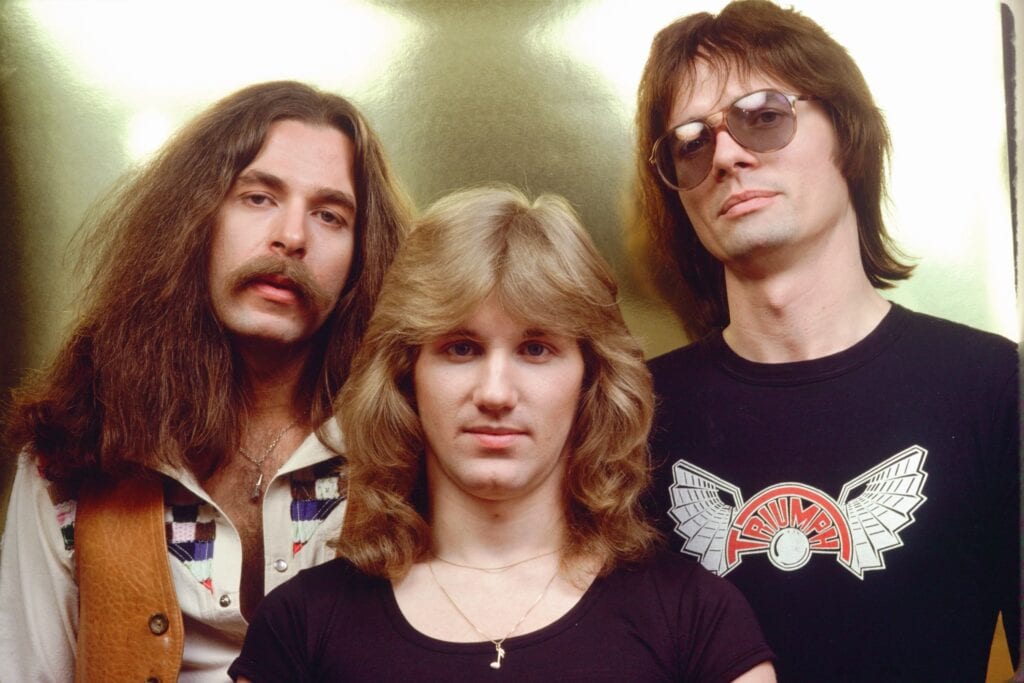
Hard-rock trio Triumph has received all the major lifetime awards in Canada, among them a star on Canada’s Walk of Fame and a place in the Canadian Music Hall of Fame. Now, as the band celebrates 50 years since forming in Toronto, it adds one more milestone — an induction into the Canadian Songwriters Hall of Fame.
It’s a particularly special honour for Rik Emmett (guitar, vocals), Mike Levine (bass, keyboards) and Gil Moore (drums, vocals) because at the core of their success is, quite simply, their songs. Hits like “Hold On,” “Lay It on the Line,” “Magic Power,” “Somebody’s Out There,” “Follow Your Heart,” and “Fight the Good Fight” led to worldwide sales of more than 15 million albums, commemorated with 18 gold and platinum records in Canada and the U.S.
“This one is the most satisfying for me, certainly,” says Emmett of the induction.
“Am I the kind of guy that imagines that I’m in it for awards? No, because I think of the three guys in the band, I’m the one that enjoyed the creative process even more than the other guys did. They loved the idea of being in a successful band and managing it and doing the promotion and the marketing, and all of that stuff. That didn’t appeal to me as much as hunkering down in a studio somewhere and writing and creating. So, this one, it feels nice to me for sure.”

Triumph’s members are all virtuoso musicians who wrote hooky hard-rock songs and had a stage show most rockers dream of when they first pick up their instruments — lasers, pyro, dry ice, the works.
“Of course, there’s that whole Wayne’s World ‘we’re not worthy’ of the Hall of Fame, like the Joni Mitchells and the Leonard Cohens,” Emmett says. “Triumph was always a bit of an outlier kind of a band because we weren’t managed by Bruce Allen or Ray Danniels; we didn’t necessarily have that kind of clout. We got in the Juno Hall of Fame [Canadian Music Hall of Fame], but we’d never won a Juno, never.
“So, we were in the industry and we were in the business, but we were outliers too. That’s a sweet thing, that there’s an outlier getting recognized. The band had certain things that other bands might have mocked us for, at a certain point, like, ‘The People’s Band,’ and all their flashpots and laser lights. So, songwriters are now going, ‘There were good songs at the heart of it.’”
While many of Triumph’s songs are staples at rock radio, “Lay It on the Line” from their third album, 1979’s Just a Game — recorded at Sounds Interchange and produced by Levine — was used recently by Rogers for its 2025 Stanley Cup playoffs television ad, and it was played a lot.
Emmett relays how his guitar string rep Larry Davidson at D’Addario Canada sent him a photo of his young nephews, telling him, “They’re your new biggest fans because they heard your song in the hockey broadcast and asked, ‘What band is this?’”
“That’s a cool thing, that kids are finding out about these songs and it’s been 47 years since I wrote them,” he adds.
Amplify learned all about the song’s origin from Emmett — and it has nothing to do with hockey.
“It started from two elements,” says Emmett. “One of them is a thing called a 2-5,” he says, grabbing his guitar but then realizing that the guitar wouldn’t come through on Zoom, so he explained it verbally using music theory.
“You know when, in the Beatles song ‘Yesterday,’ ‘yesterday, all my troubles seem so far away,'” he sings, “that chord change — F-sharp to a B to an E minor — that’s a 2-5. I’d gone to Humber [College] and I’d been a jazz guy. I had learned repertoire that was standard, played-at-weddings kind of songs. There’s a lot of 2-5s in them.
“So I had this idea for an arpeggiating intro that was a 2-5. I had a little bit of an idea cooking there but what was I going to sing about it? When I was in bar bands, we had learned the song ‘Rock and Roll, Hoochie Koo’ [by Rick Derringer] and it had this [makes grinding vocal sound] little chords and I went, ‘That’s a good thing.’
“And, of course, ‘Stairway to Heaven,’ the guitar solo went, ‘bah bah, bah bah, gung gung gung’ so it had those bang bang, bang bang. So I was thinking, ‘I’m going to have a bang bang song,’ and try to tie the 2-5 into it. And when I started writing, that’s where it started from.”
The lyrics, which include the repeated hook “lay it on the line,” was not based on his current relationship, but it was a reflection on unrequited love.
“It was nothing in my personal life because I was perfectly happy with my wife. We were having an idyllic relationship,” Emmett says. “I was thinking about girlfriends that I had in high school where they weren’t honest with me. They were seeing other guys and when I found out about it later, I wished they’d just been honest with me.
“There’s a line in it that I really like in the second verse. The singer goes, ‘I don’t ask for much / The truth will do just fine / won’t you lay it on the line.’ I just loved that line. There’s a bottom line being established, so lay it on the line — the line is a bottom line; the line is truth; the line is honesty.
“I go, ‘This is f**king awesome. This is so Canadian,'” he says of coming up with it. “But, it’s also a really good thing for the band to be projecting this thing of ‘We have our integrity and our integrity is a bottom line. Our bottom line is the truth. We’re not gonna be bullshit.’
“Now, you know, some people go, ‘Triumph with all of their makeup, show and lights [laughs], who is he trying to kid?’ But the fact of the matter is everything always boils back down to the song. The songs are the bottom line of a band.
“If the song is saying, ‘I don’t ask for much; I just want the honest truth,’ that’s universal. Everybody can relate to that. So I was quite proud of myself.”
After the soaring harmonies of “lay it on the line,” there’s also the ultimatum, spat out angrily: “Don’t waste my time.”
“Yes, well, there is that. The singer definitely is going ‘I’m pissed. I’ve had enough,'” Emmett says, but really, he acknowledges, it’s also just about finding that right rhyming couplet.
“You’re a songwriter and you’re sitting there and you’re going, ‘Line, what rhymes with line? Fine. Mine. I can have time and I can have kind. So some of that, you can trace it back to that.
“When I was teaching it at college, I would tell songwriting students the rhyme words don’t really matter that much. There’s probably a lot of songs that use the word line in order to rhyme because they’re good words to sing, but what’s the sentence that leads up to it? What’s in the phrase that’s going to really set your song apart?”
He says the guitar solo “is over an ‘Autumn Leaves’ cycle of a [sings the progression] D minor to a G to a C that walks down A minor to a G to an F to an E dominant 7 to an A minor to an A7. This is a progression that is fairly classical in nature that jazz guys used a lot,” Emmett explains. “That was because Queen had been very influential for me.
“Brian Wilson of the Beach Boys said, ‘I can fit symphonies into three minutes,’ and I went, ‘Mike, I want to try and do this. I want to try and have songs that have different sections that do different things, that have bridges that go someplace else, that might go out of the key that might come back, parts that don’t recur.
“But ‘Lay It on the Line’ probably owes as much to ‘Stairway to Heaven,’ ‘Killer Queen,’ and ‘Bohemian Rhapsody.'”