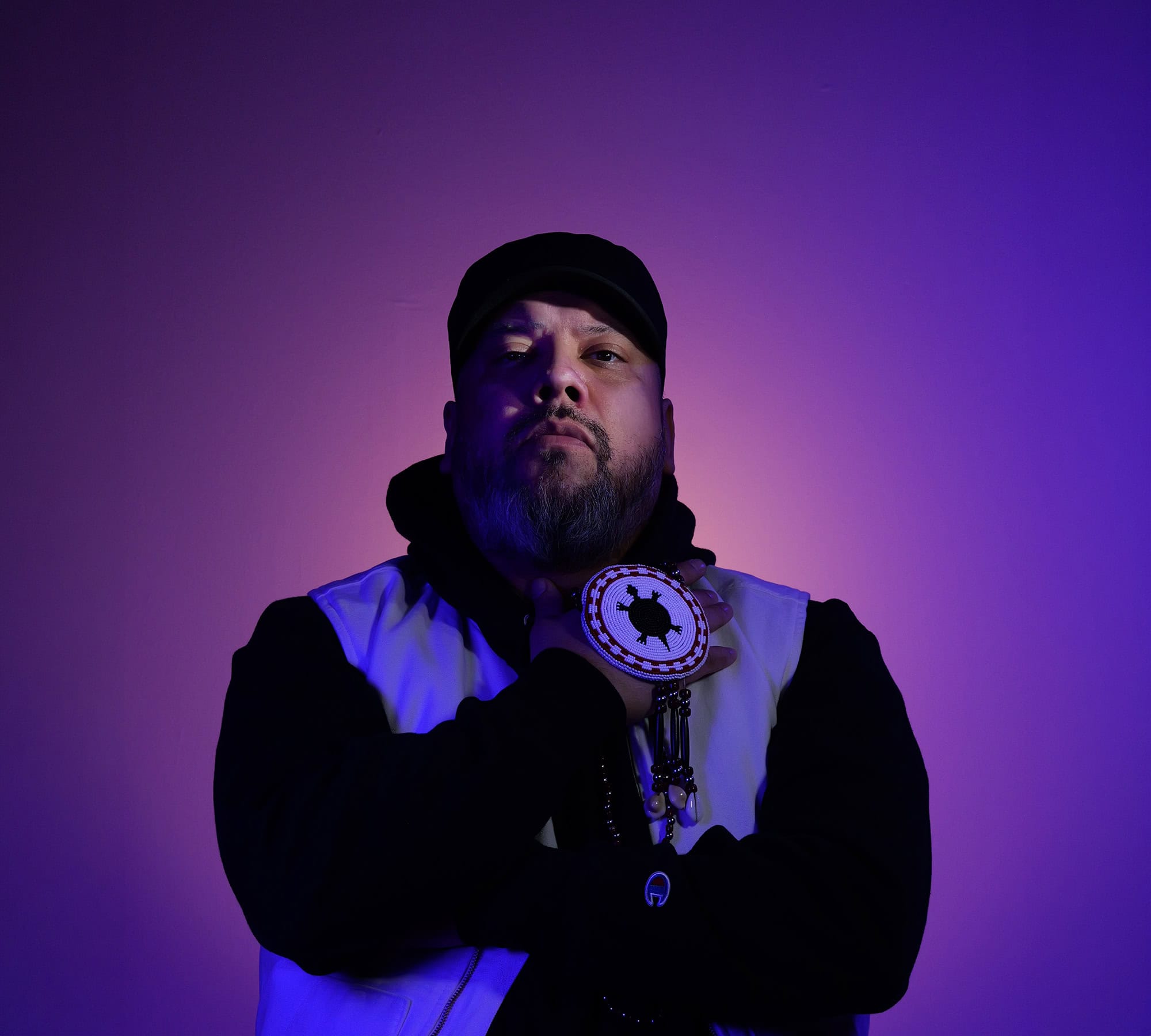
Every record asks the same question of its creator: what happens when something that belonged to you no longer does? With Heritage (Part Two), Dan General — known professionally as DJ Shub — is still searching for an answer. For him, the release of a new album is not just a calendar marker but a handoff. A piece of work that has lived inside him for months, sometimes years, now leaves his control entirely. He compares it, half-laughing, to sending a kid off to college.
“It’s always that scary, exciting kind of thing,” he says. “It’s a mixed bag of emotions. You’ve been working on it for a while and then it goes and does its thing.”
But even in that uncertainty, there is clarity. Music has always been about transmission, and long before DJ Shub understood production, genres, or even DJ culture, he understood records as something closer to portals than objects.
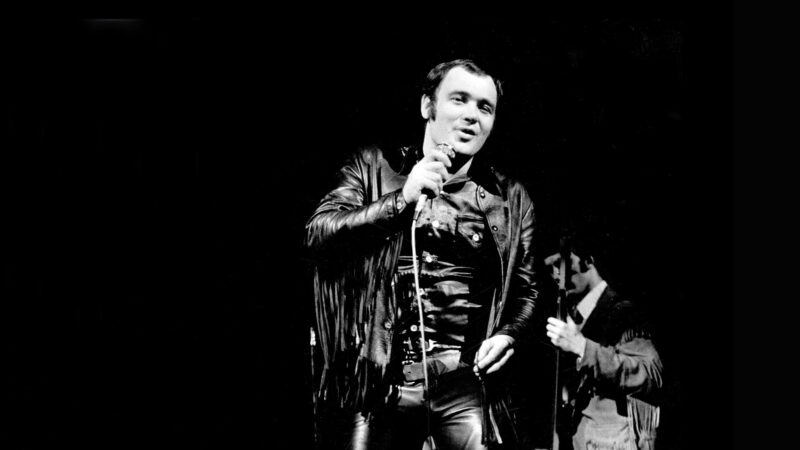
Growing up on Six Nations of the Grand River, young Shub was surrounded by sound in ways that did not yet have language attached to them. One of the earliest anchors in his memory is a vinyl record released by relatives: his uncle’s band, Sam and the Country Braves, one of the first records to come out of the community. He remembers studying the cover. Then the ritual of placing the needle down and hearing the room change. And then something stranger: the people on the record were not just voices anymore. They were real.
“That always amazed me,” he says. “It felt like music could take you somewhere. That’s why it holds such a big place in my heart. I’m connected to those types of moments.”
That idea — that sound is travel and that it collapses distance between people, time, and place — never left him. It simply evolved.
Shub’s early music career was defined by collision. DJ competitions, basement practice sessions, early electronic scenes, and a formative education in genre promiscuity shaped his instincts. He followed his older brother into DJ culture, absorbing everything from hip-hop to heavy rock. At one point, he was in a Limp Bizkit cover band, trying to impose structure on chaos. It sounds incidental now, but it tracks. Even then, he was learning how to move between worlds without letting them cancel each other out.
But the real shift for DJ Shub came through recognition. At an Electric Powwow party in Ottawa, Shub witnessed something that reorganized his understanding of what music could be. Onstage, members of A Tribe Called Red (now The Halluci Nation) were blending traditional powwow rhythms with dubstep and electronic bass music. Shub recalls that the moment was not just sonic but also very social.
“It was all First Nations kids,” he recalls. “And what I learned afterwards is that these students that came in to listen and to be in a safe space, they really took that music as their own, as the soundtrack to what they were doing. That was the moment everything changed. I didn’t know it at the time, but I was watching the music I was meant to make.”
From that moment forward, what would become known as powwow-step stopped feeling like an idea Shub was approaching from the outside and started becoming something he was accountable to from within.
Powwow-step emerged during a moment when Indigenous artists were increasingly refusing inherited expectations about authenticity. The music did not arrive through institutions or critical frameworks. It arrived fully formed on dance floors, at gatherings, and in protest spaces already charged with political urgency.
“You know, when powwow-step was first introduced to a lot of people, there was a big protest going on in Ottawa, Canada, like the Idle No More protest,” he recalls. “And during these protests, they would play our songs. So it really had a huge impact. The times really had a huge impact on the sound and the music we were creating.”
If the early years for DJ Shub were about discovery, 2022’s War Club was about turning lived experience into something sharp enough to cut through noise. The title references a traditional Mohawk weapon, but Shub is careful not to let metaphor soften its meaning.
“It’s a weapon we used in war times and that was one of our main weapons. If you ever get to see it, it’s a pretty intimidating little piece of equipment. It’s a club with a big knotted piece of wood on the end,” he says. “And that’s exactly what it’s for, to hurt people. And so I kind of use that as a reference, like, okay, I’m going to make music my war club. I’m going to make this music so you have to listen to it and it’s going to be in your face and you have no choice but to dance and listen to it.”
The album emerged from a period of personal collapse and recovery. Shub had entered rehab, confronting addiction and the instability it had created across his life and relationships. What came out on the other side was not a reinvention but a re-centering. Music, once again, became structure.
“War Club was me coming out of that,” he says. “It was me getting my family back.”
The record does not try to hide its intensity. It leans into it, with sonics that are direct, physical, and almost confrontational. Underneath that, however, is something quieter: the discipline of survival after disruption.
DJ Shub’s sophomore full-length studio album Heritage, on the other hand, is about reconstruction. The original concept was enormous, with more than 40 tracks accumulated across years of work. It was too large to function as a single release without losing shape. The solution was division. The project became two records: Heritage (Part One) and Heritage (Part Two).
The split, he says, was not just practical. It changed the listening experience itself. It allowed space for collaborators, interludes, and voices that might otherwise have been pushed into the background.
“It gave me room to showcase more artists,” he says.
Among those collaborators were Tia Wood, Aysanabee, and Natasha Fisher. Each session carried a different emotional weight, but the process remained consistent: build together, listen first, and let the track reveal its own direction. One collaboration in particular, “Eye of the Storm,” became deeply personal. Fisher, who is also in recovery, met Shub in a shared language that required no explanation.
“We were in the same place,” he says simply. “That’s why it worked.”
As Heritage developed, so did the cultural context around it. Shub is direct about what he sees as a growing issue in Indigenous creative spaces: what he calls “pretendingism” — people falsely or loosely claiming identity for access, credibility, or institutional gain.
It is a tension that makes Heritage feel less like a retrospective and more like a boundary statement. Because beneath the music is a question that cannot be separated from it: who gets to tell these stories, and under what authority?
For younger artists watching from the outside, Shub’s career can look like momentum. But when asked for advice, he avoids framing it as inspiration. Instead, he talks about inertia.
“The most scary thing is change,” he says. “But even scarier is not changing. I think having that right support around you, having those people that believe in you around you, is the best thing for you. And I think taking that leap of faith is something that you’ll never regret. You’ll regret not taking that leap of faith.”
Toward the end of our conversation, Shub shifts tone. The language slows and the answers become less about music and more about what music has cost him. Time, he says, is the thing you do not get back. Especially time with family and time lost to touring cycles, substance use, and that constant motion disguised as productivity.
“You can’t get time back,” he says.
Taken together, War Club, Heritage, the early powwow-step experiments, and the Electric Powwow origins do not resolve into a narrative of success but into continuity. Not preservation in the museum sense, where culture is placed behind glass, but preservation through use.
Music was never static for him. It began with a record spinning on Six Nations, voices crossing impossible distances through speakers. Decades later, the mechanism remains the same. The technology changes. The frequencies change. The communities change. The act of transmission does not. And neither does the refusal to let it stop moving.