
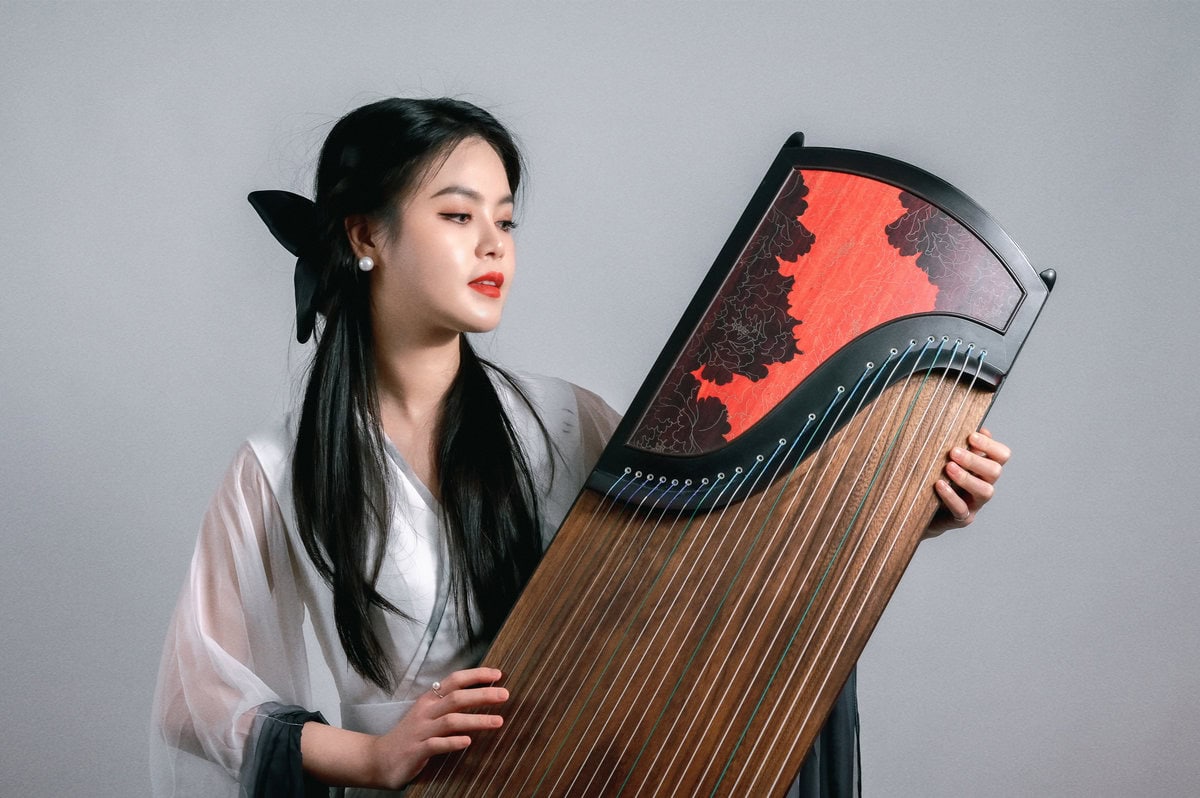
In mid-November, at a little end-of-the-world feeling pub in downtown St. John’s, Newfoundland, Jing Xia took the stage to play her original guzheng compositions, including « Love – The Breeze » from her upcoming solo album to be released in May 2026. Despite The Ship Pub’s reputation for, perhaps, an atmosphere that’s a little more on the louder and rowdier side, Xia’s intricate songs and the performance flourishes that help lend them their dynamism had the patrons hushed.
Later that weekend, at the much bigger rock venue aptly named The Rock House, she and her group Xia-3 filled the room with a sound that cops from prog-rock, post-rock, and heavy metal, driven by Xia’s incredibly nimble playing, and with a tightness that can be attributed to her classical training.
Outside of performing, Xia is also a scholar of music, and holds a PhD in ethnomusicology, for which she studied the diasporic experience of professional Chinese instrumentalists living and working in North America, including their intercultural music-making, transnational music projects, and some traditional music-making.
Xia has been playing the guzheng since she was six years old, and notes that the traditional Chinese zither has over 2,500 years of history. She uses the standard contemporary version of the instrument, which has 21 strings—an evolution from the original’s 13—but there are also versions with up to 26 strings.
“Some elderly musicians, especially Chinese musicians, call it a zheng, without the ‘gu,’ because zheng is the original name of the instrument,” Xia says over the phone from Ottawa, where she’s attending a music conference. “The ‘gu’ means ‘ancient,’ so the whole term means ‘ancient zheng.’ It’s a way of acknowledging the tradition and history. But some elderly musicians may not like that.”
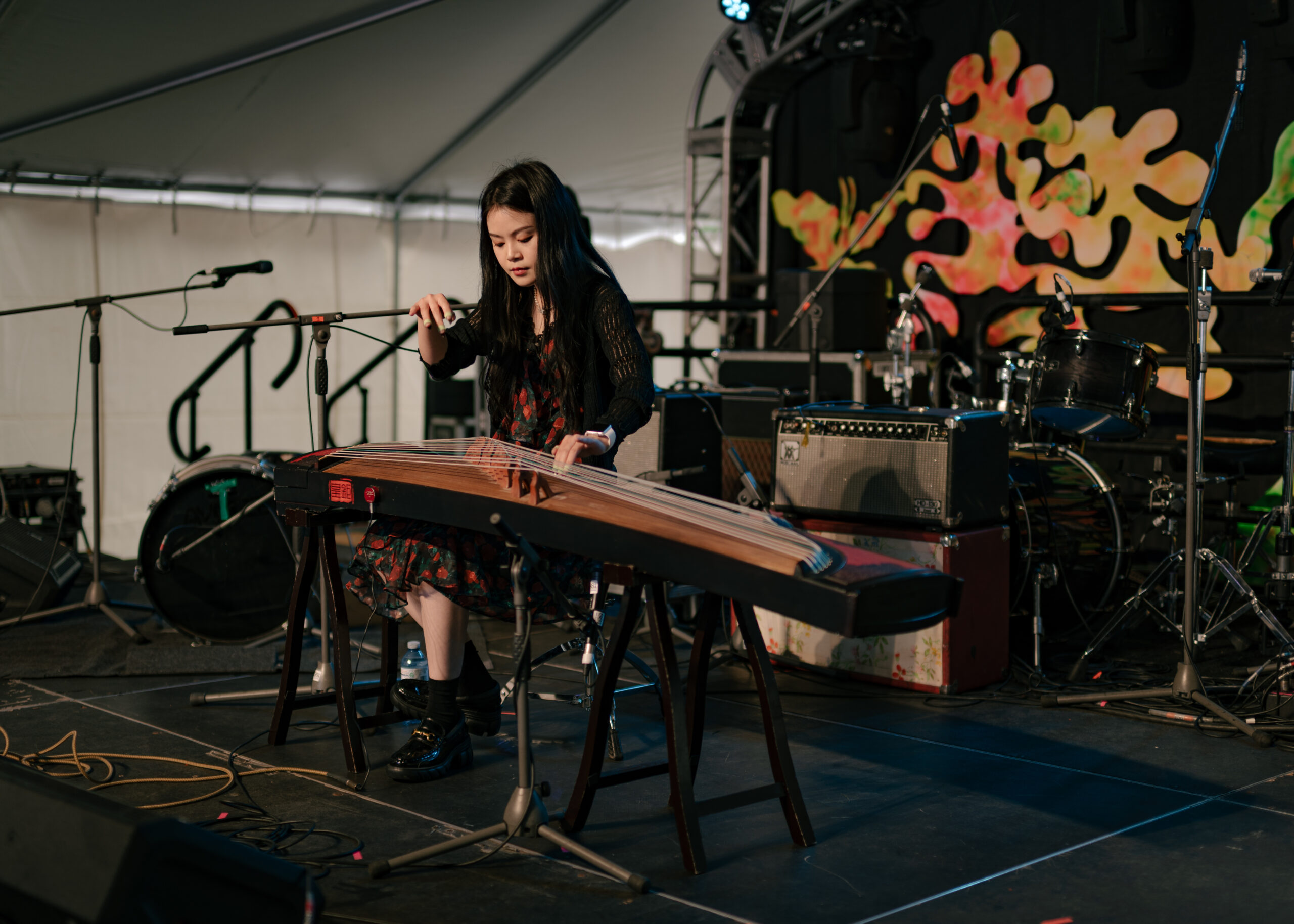
Xia’s aunt was her first guzheng teacher. “At that time,” Xia says, “I was just purely attracted by a sound. It just sounds so beautiful to me.” Many of her other relatives worked in music as well, so she grew up around it. But, while she was still a kid, the rigor of practice and study of music bored her after a while, and there began a time where she almost hated the instrument because of the constant push to perform. It was school during the day and practicing the guzheng in the evening.
“Basically, every day was full,” Xia says. “I remember there was a time I had this big fight with my mom, and I locked myself in my room, and refused to talk to her. And she actually slipped a piece of paper with my performance schedule on it under the door. I cried so hard, I felt like my life was ruined by this instrument, this kind of performance. As a kid, I didn’t realize my mom actually did everything for me. Without that push, I wouldn’t have achieved what I have today. So I now feel very grateful for what my mom did to me, but I remember that period of time was very hard for me.”
How did you come back to the guzheng?
It’s not like, in a moment, I suddenly came back to it. I guess I gradually accepted it, you know? And I think my mom did a good job in educating me about the importance of all the performance, and showing me the meaning behind it. I remember she told me, ‘You’re not just doing this for yourself. You do this also for all the people listening to your music.’ That was a very moving moment for me. So, I guess I grew up with that kind of responsibility in mind. I felt like, I’m sharing my music and I have to practice hard to really learn how to play it, so that every time I present it, I present it—at the time, I thought—in an ‘authentic’ way. I know authentic is a very tricky term, and we now avoid using that term. But for a long time I felt I must practice hard to present the authentic music of this instrument. So, it took a long time, but then I found my meaning. I went to school to get my bachelor’s degree in music performance and then I just never stopped.
What are your favourite guzheng compositions?
There’s a piece called “Fantasia” by Wang Jianmin that I really love. “Huan Xiang Qu” in Chinese. The standard tuning for the instrument itself is the pentatonic scale, but for that piece it changes and uses altered tone, and you introduce an almost atonal vibe to the piece, very different. I really love that kind of innovative move. I think that’s also why now I do a lot of fusion music, a lot of non-traditional music.
At The Ship, you mentioned you have a new solo album coming out soon. What is it like?
It involves intercultural music making. Although it’s a solo album, on every track I include some other instruments, like keyboard and drums and bass. I was very lucky to have Andrew Kagumba play African drums on a piece with me, and also Persio Domingue from Dominican Republic, who also played traditional drums on it. That’s a piece about hatred. I think I mentioned this in my concert, that the album is about human emotions. What I wanted to achieve through my instrument, collaborating with other Western and non-Western instruments, is intercultural music making, making music together to express the common human emotional stress we have. It’s also based on Confucius’ philosophy of seven core human emotions we have in common. All humans on Earth share the same seven core emotions. Each piece represents one of those threads. (Editor’s note: those seven emotions are joy, anger, sorrow, fear, love, hatred, and desire. Xia adds an eighth track to the collection called “Harmony”).
How does your approach to the guzheng change when you work with Xia-3?
Every time I mention I play in a post-rock band, people give me a shocked facial expression! Making music with them is very fun and very different, and a learning experience, because they don’t read music. I guess that’s the same thing for many rock and folk musicians, or that’s my experience, anyway. They may read some chords, but that’s it—they don’t really have a score in front of them to read and learn and play together. I had to learn that part. I’m a classically trained musician. I wasn’t trained to be a composer who can write music. So that was kind of my first time moving out of my comfort zone and trying to write music. Writing with them without the burden of sheet music in front of me was very fun, very different. I learned how to listen to each other, learn the patterns and how to communicate, and then put communication down as a score. Not a traditional score, but something, as a structure, that I can follow. To be honest, at first, I just wanted to try something different. I didn’t expect anything, like the full-length album, to happen. I just thought, ‘I want to use this traditional instrument with post-rock music and see what happens.’ And then it was just a pure joy to work with the guys.
After so many years of study, do you still feel there are possibilities for your work with the guzheng?
Definitely. It is always a learning experience, right? Many masters, virtuosos, would agree with me—don’t restrict yourself with what you’ve learned, what you already know. Because after so many years of learning, your manner can be so rigid, the way you think of your instrument, the way you play it. It becomes part of you, you just play it that way. That’s why I recommend collaborating with other musicians: it gives you a new way of looking at your instrument. Every time I play with a new musician or a musician with a different instrument or from a different cultural background, it’s a learning experience for me. I play with them to see what I can change—to make it a version for us.