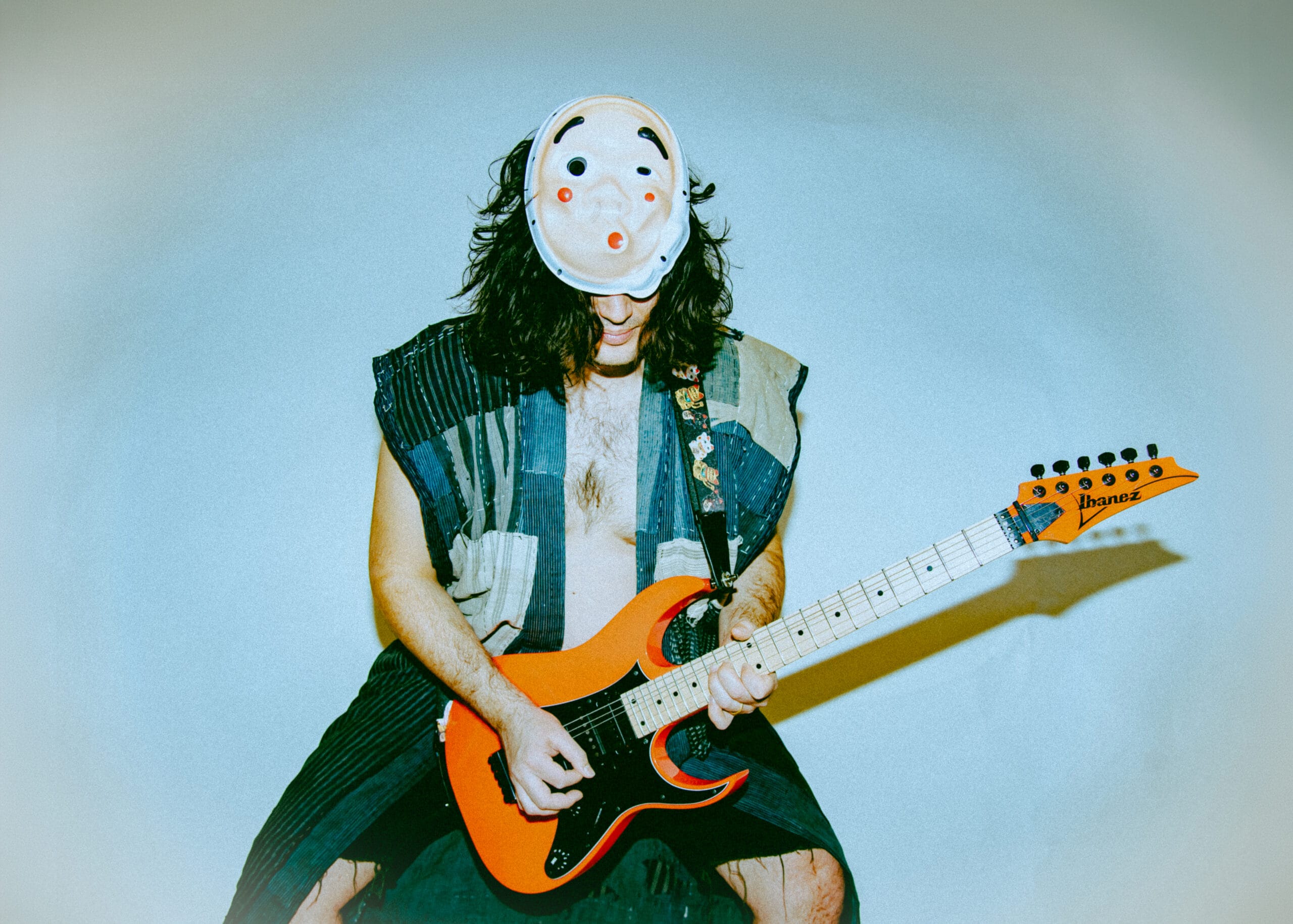
Even though his child is not napping despite it being the correct time of day for napping to happen, Hiroki Tanaka sounds pumped to chat about his pedal board. A quick dip into his latest solo record, the wildly multi-faceted Isan (translated into English as ‘inheritance’)—for which Tanaka wrote new songs based on obscure hymns “composed by Japanese-Christians in the early 20th-century”—is all the evidence one needs to know the former Yamantaka // Sonic Titan guitarist knows his effects. The enthusiasm of the endearingly nerdy is nearly palpable as he speaks over the phone from east end Toronto, sheltering from the mid-July wildfire smoke.
“In high school, I went to Rosedale, this art school, and they were pretty open to me fucking around,” Tanaka says. “I would bring my saxophone and nine effects pedals that I’d collected and I would link them all together, put the microphone into the bell of my saxophone, and I would play. You wouldn’t even be able to hear the saxophone. Basically, it was just feedback from the phasers and the distortion pedal and the delay. Everything going all at once. I fell in love with effects and noise.”
He also strapped a bunch of pedals to hockey shoulder pads once and walked around the school with an amplifier, creating and messing with “scrongly” sounding feedback as he traipsed the hallways. Eventually he ditched the saxophone and started up on guitar, learning from Paul Linklater (Bidiniband), learning rock ‘n’ roll and Radiohead tunes and the like, moving on to classical, and then doing his Royal Conservatory of Music grades while simultaneously messing around on his own and digging into experimental artists like Animal Collective, John Zorn, and Melt-Banana.
“There were a lot of prodigiously good musicians at my art school, so I learned very quickly that I was not,” Tanaka says. “I was like, ‘Screw that! I’m not gonna be a technically skilled person. I’m just gonna be the weirdest left-of-centre artist here, and get really into noise music and experimental sound.’ Pedals were my opportunity to do that.”

- Union Tube & Transistor “Tone Druid” (sweet OD)
- DEATH RON’S DEATH DRIVE (made by a bandmember of WARM out in Vancouver)
- Weeping Demon Wah (mediocre wah but great Lo Pass filter sweep!)
- Julia Chorus/Vibrato
- dat big green DL4
- Holy Grail for a pinch of verb
- DD-5 permanently stuck on “Hold” mode so that I can get that Melt-Banana-style glitch sound!
- Volume pedal for all the swells and such.
But Tanaka was interested in “finding the pop” in those experiments. For a long time, he was into recording sounds and chopping them up and turning them into beats or strange ambient soundscapes.
“But the unfortunate reality is that if you ever want to play with other people and not just do a noise project, you have to figure out how an instrument actually works,” Tanaka says.
He became more discerning about effects in the mid-2010s when he joined Yamantaka // Sonic Titan. He was pressured to trade his Boss Metal Zone for a Pro Co RAT.
“Especially something like Yamantaka, which was very orchestral and had a lot of moving parts. I couldn’t just take up all the space and be out of control,” Tanaka says. “So there was a real culling. I think at one point I had like 14 pedals on my pedal board or something insane. In a live situation, you can’t trigger—with your foot—multiple pedals in a way that’s set up so you get the sound you want. You really have to figure out: ‘How can I economically achieve the sound that I want with as little footwork as possible as we navigate song changes?’ I think now I’m down to eight or nine pedals.”
What kind of mental shifts came along with the opening of sonic worlds that pedals provided? How has it affected your songwriting?
What I wanted to do in the early days with effects was about creating this huge swarm of noise and then messing around. So having essentially all of the effects on. It’s a very teenager approach. It’s like the canvas when you put all the colours together, and it becomes the colour of mud or whatever, right? Yeah. Refinement of that is I think partially necessity being the mother of invention.
I think a lot of my tone now is about utility and being practical in a live sense and transitioning into, “Okay, I need this certain sound,” or “I want to get this kind of effect.” Especially in the 2010s I became a lot more discerning. I went through so many different pedals trying to find a good sound. I got the Waza Craft distortion. I even tried circuit bending a Boss Distortion pedal once. I tried the aforementioned RAT pedals. Also, amps. I just aggressively experimented, and I went on Kijiji and bought a MESA Dual Rectifier. I had a giant—it was so stupid—a giant 412 Dual Rectifier in my living room, just taking up so much space. My roommates were just like, “Oh, dude, what the fuck? And then being in a six-piece band with Yamantaka, Alaska B (the band’s co-founder) brought down the hammer. Like, “No, you need a 1×12 cabinet and a small amp. No one is going to help you lug these things. If you ever take these giant amps on tour, you have to carry it all by yourself.”
Isan involves reinterpreting music. How did you consider that interpretation on a granular level, with each song’s building blocks?
What I would want, and perhaps what I’ll have to focus on if and when I ever make another record, is really being able to dive into more of that ambient guitar sound. I think I really did sort of a classic rock thing, both in Yamantaka on the Dirt album and in this last album where I was essentially working as a band. And I think having now done that, I kind of feel free to do whatever the fuck I want. I would love to get the Red Panda, the Particle 2 Granular Delay pedal. Really get into weird Empress stuff. It would be a lot of fun for me to experiment with those kind of pedals and get back into kind of a return to my teenage self who was just like, all pedals go, see what weird sounds come out. “What can I do with that? How can I turn that pop?” I would love to do that.
The hymns, in my mind, were about songcraft. The actual writing of the song, the lyricism, the melody, and the approach. Whereas the production of it, the sound of it… I wasn’t about to do a ye olde hymnal section or something like that. My goal was to utilize the hymns and the writing of the hymns toward my musical sensibilities. So they were a vehicle for me to try out any genre I wanted to or try any song. In that sense, the hymn itself didn’t determine what tone I would use so much as the necessities of the song did.
I think the jangly weird synth-pop of “Nation of Love” was very much a preoccupation with this light guitar tone. I think a lot of it’s hidden now beneath all the synths because we were trying to make a synth-pop song like Taylor Swift or something. Then “Tomogaki” in my mind sounds almost like a King Crimson record—everything’s dry mic’d in a weird way, and it sounds almost vintage. I think Kohen Hammond played a lot of that. We had a lot of vintage gear at Revolution Studios. We’re talking like a 1967 Neumann U 47 or whatever, “real McCoy” multi-thousand dollar vintage tube mics. We had the opportunity to make it sound like an old record, and in some cases we did. Even “Yamato,” I think in a lot of ways, followed that route. In that sense, I think my guitar tone kind of does have a practical vintage vibe a lot of the time. It doesn’t sound like a very modern, cutting-edge kind of tone. I’m not trying to do the kind of things like any number of modern guitarists who are going viral on TikTok. I don’t sound like that ever.
What’s a particularly significant example of using effects on Isan?
For “Unbinding,” it was so great to have a guitar solo in lieu of a chorus. Instead of a second chorus with vocals, it’s just a guitar solo, and I think I did that right. It has this ’80s, almost gothy rock vibe, you know, a little bit of that kinda ’70s, ’80s pop sensibility to it, which is really fun for me. Guitar effects-wise, it’s sort of like, the quintessential tone. I go through this surf-rocky thing, it’s got a warbly chorus plus a reverb and a delay to create a kind of [makes zoomy sci-fi mouth sounds]. And I’m working the whammy bar on my guitar, and then in the choruses, I have these huge, heavy chunky riffs to give it that kind of sludgy-pop vibe I was going for at the time.