
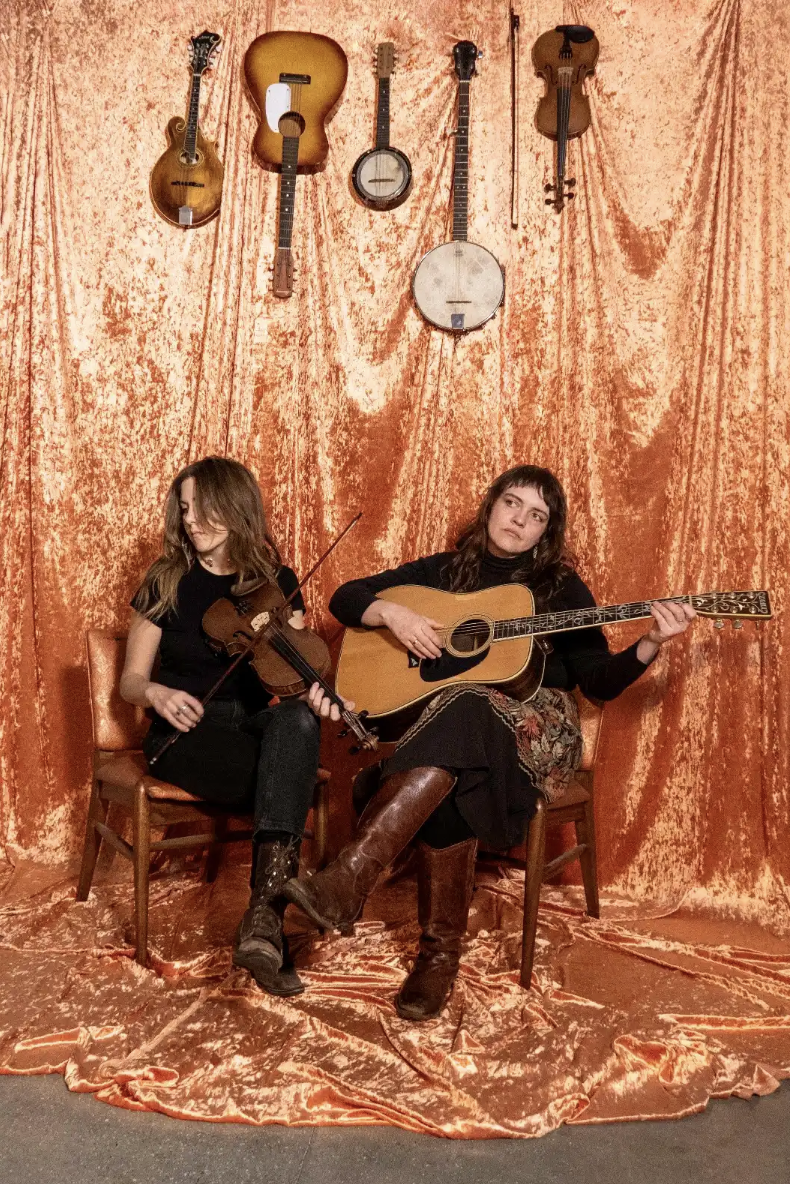
Lisa Maria, one of two multi-instrumentalists in the (partly) Nova Scotia-based folk duo Mama’s Broke, is some fiddler. With Amy Lou Keeler, Lisa Maria makes music influenced by traditional folk styles of all kinds—British, Ukrainian, Cajun, and Appalachian to name a few—that perhaps is best described by the overused but, in this case, entirely appropriate adjective haunting. Their earthy harmonies haunt; Lisa Maria’s fiddle, whether heartsick or spirited, haunts. Even the cover of their new record, Reunion, feels haunted. The duo’s engagement with sounds and styles so steeped in history reminds listeners that, as the writer William Faulkner put it: “The past is never dead. It’s not even past.”
“I think music had always been a part of my life in some way throughout childhood, but it wasn’t really until in my teenage years that the fiddle really took over as a predominant thing in my life,” Lisa Maria says over the phone from New Orleans. “When I first really got into it, I was busking on the street. I was playing a bunch of different instruments, the fiddle included, and that to me really felt like a foundation.”
She’s only ever had two fiddles in her life. The first was a Jay Haide violin, a more modern model, which she thought she would have for the rest of her life. But it met a tragic demise one night when the tailgate of her truck broke and the instrument flew out down the highway. From then on, she scrambled to find another fiddle for a while, until eventually one popped up on Craigslist in Cape Breton. Without much information except for a blurry photo that sort of looked like the fiddle fate had snatched from her, Lisa Maria drove five hours to the stranger’s house so she could check it out.
“He had gotten this fiddle from an estate sale, and it had been sitting in an attic for a long time, and he didn’t know anything about it,” she says. “I tried playing it, and the first thing I recognised was that the neck, the fingerboard, felt very similar to the fiddle I had lost. Since then, I’ve discovered that style of build has a much narrower neck, and I think that’s a quality I’m drawn to. But I ended up getting it at the time mostly because it was something I could afford. It was a steal of a deal, and the feeling was similar, and it also had a darker tonal quality to it that I liked. I did a little digging about it, and it turned out it used to be owned by a guy named Danny Fraser, who was a well-known Cape Breton fiddler.”
During the recording of Mama’s Broke’s last album, the fiddle suffered a large crack, and when Lisa Maria brought it to a luthier for repair, his best guess was that it was made in 1880 in Germany. It’s the layered fiddle that can be heard on the uneasy “Fifolet Waltz,” squarely in what Lisa Maria calls her comfort zone, “sticking with the warmer, rich notes.” And it’s in conversation with Paul Kowert’s bowed double bass, “channeling a bit more of a psychedelic angle” during an improvised section about three quarters of the way through “Bridges.” “I think in that moment you really get to hear the full scope of the range of the violin because I’m playing in every position, down and up the neck, bringing out a lot of different tonal qualities,” Lisa Maria says.
How would you characterize your relationship with the fiddle?
In some ways, it’s always been a way to help me make sense of things. I think back when I was 18, I was on the streets a lot and busking. And looking back, there are many paths I could have gone down, but the fiddle really gave me a way through, and was able to open a lot of doors and connect me with communities and cultures around the world that I probably otherwise wouldn’t have. In some ways, that’s still true today. It’s still a means of how I travel and connect with people.
How have you evolved with it stylistically?
Stylistically, I’ve always been all over the place. The fiddle is such a versatile instrument. I think some of the first music I was playing on it was influenced by some of the music I was listening to at the time, which was like a lot of psychedelic rock and going down the rabbit holes of bands like Curved Air and King Crimson, but then I just kept chasing down further until I got into the jug band string bands from the 1920s and 1930s. But even before that I had a dream of studying classical Indian violin, spent a year in Asia, and quickly discovered that was not the style I wanted to pursue for the rest of my life. I lived in Romania to study the traditional music there. So I think it’s just constantly been morphed by the style I’m currently influenced by.
What are the styles of playing you feel closest to?
I think it’s really traditional music as a whole. I wouldn’t say I specialize in any particular style. I think some of the first tunes I ever learned were Scottish and Cape Breton tunes. However, if I’m sitting down in an Irish/Scottish jam, a lot of people say, “Oh, you must be an old-time fiddler.” But then if I’m sitting down in an old-time jam, I get called out on, you know, being a Scottish fiddler or something of the like.
What draws you to traditional music?
It’s a kind of rawness, or a foundation to help me understand a different culture. All traditional music is stemming from the people in some way, and there’s a lot of history and emotion and storytelling that all gets wrapped into traditional music and I feel it has this real human connection at its core.
Who are some specific players who’ve influenced you?
The most consistent are just the people I’m surrounded by and friends. I have a friend down here, Noah James, and I’ve always loved his fiddle styles. I’m not sure if he would have anything online, but he’s an incredible fiddle player. Someone who can morph through a lot of different styles. If I’m going through more specific genres, like in the old-time world, I tend to be drawn to a lot of tunes coming out of West Virginia and fiddle players like Clark Kessinger and Ernie Carpenter. I can still remember the first time I heard Ernie Carpenter’s song “Yew Piney Mountain,” and that was definitely one of those gateway tunes into old-time music for me.
Someone was just playing it in a backyard, and I had to figure out what it was. I think it captured this quality I love about some of the more Irish/Scottish modal tunes I was familiar with, but it had these long, drawn out, soulful bows that capture a kind of yearning I’ve always been drawn to in tunes.
What do you think is special about the fiddle’s evocative emotional qualities?
I think out of any instrument I’ve played, even including my singing voice, the fiddle has been the one I keep going back to as far as feeling like I can express myself best with it, and I think a huge part of that has to do with the bow, and its subtle nuances. I feel like with the bow, I can manipulate the emotion of the tones in a way similar to the human voice, but in a way that comes easier to me.
Do you connect any particular emotions with the instrument more than others?
I think it’s so versatile that it could literally be any emotion. Definitely joy, definitely sorrow, and you can also even bring out anger and frustration or tension. But also, healing.